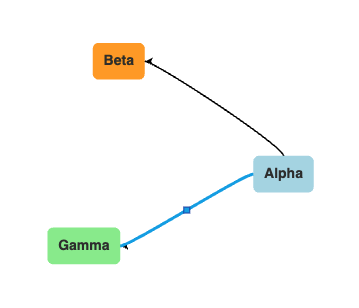
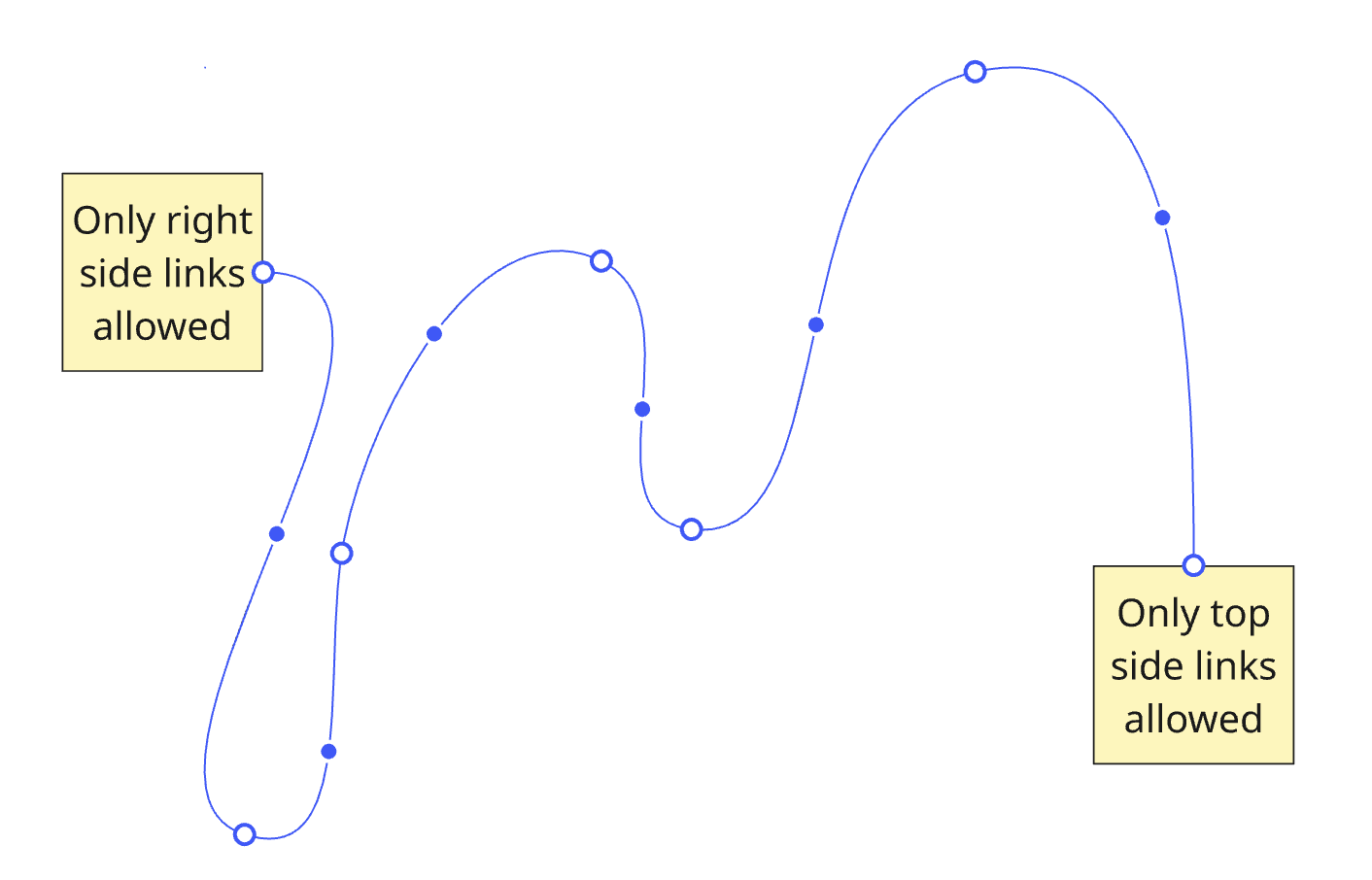
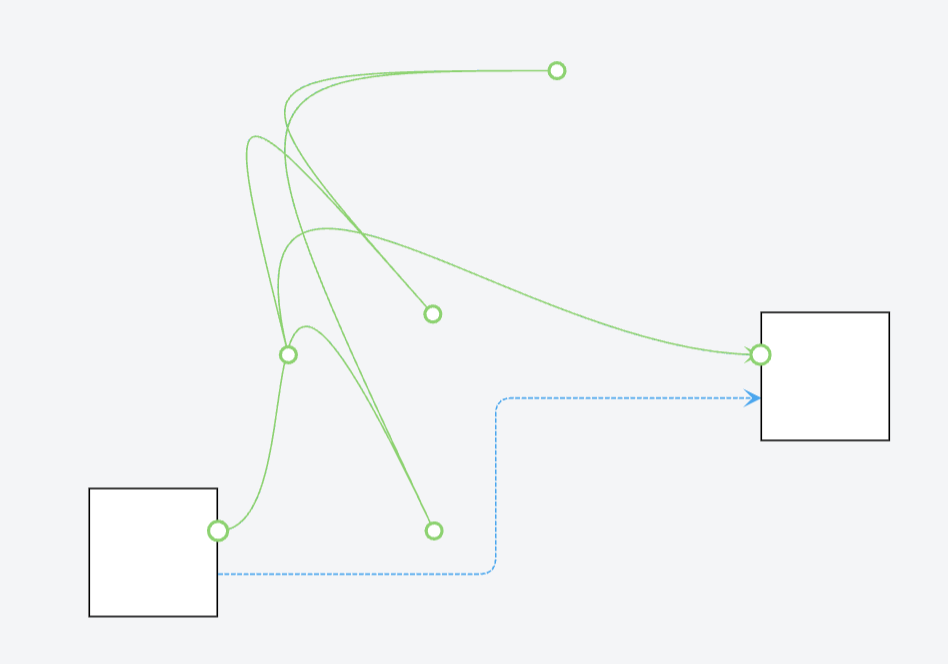
[EDIT: improved]
This doesn’t have support for adding or removing segments (i.e. individual Bezier curves), but I think it has some of the things you are looking for:
<!DOCTYPE html>
<html>

<head>
  <title>Double Bezier Link</title>
  <!-- Copyright 1998-2025 by Northwoods Software Corporation. -->
  <meta name="description" content="a custom routed Link that always has two Bezier curve segments in it">
  <meta name="viewport" content="width=device-width, initial-scale=1">
</head>

<body>
  <div id="myDiagramDiv" style="border: solid 1px black; width:100%; height:600px"></div>
  <button id="loadModel" onclick="load()">Load</button>
  <button id="saveModel" onclick="save()">Save</button>
  <textarea id="mySavedModel" style="width:100%;height:200px">
{ "class": "GraphLinksModel",
  "nodeDataArray": [
{"key":1,"text":"Alpha","color":"lightgreen","loc":"0 0"},
{"key":2,"text":"Beta","color":"yellow","loc":"-100 189"},
{"key":3,"text":"Gamma","color":"lightgreen","loc":"100 0"},
{"key":4,"text":"Delta","color":"yellow","loc":"100 189"},
{"key":5,"text":"Epsilon","color":"lightgreen","loc":"200 0"},
{"key":6,"text":"Zeta","color":"yellow","loc":"300 189"}
],
  "linkDataArray": [
{"from":1,"to":2,"points":[58.28947448730469,19.547368192672728,87.29297828674316,48.6140338420868,20.824562072753906,83.3649121284485,-2.9078941345214844,109.94035076300304,-26.640350341796875,136.51578939755757,-74.10526275634766,179,-74.10526275634766,189],"adjusting":17},
{"from":3,"to":4,"points":[171.2894744873047,19.547368192672728,181.2894744873047,19.547368192672728,214.59299659729004,82.81403079032899,158.22629737854004,97.38071169853211,82.85965919494629,114.48071780204774,79.69297218322754,154.3807116985321,127.69736862182617,189],"adjusting":17},
{"from":5,"to":6,"points":[267.68421173095703,19.547368192672728,277.68421173095703,19.547368192672728,293.6315797170003,83.3649121284485,301.605263710022,109.94035076300304,309.57894770304364,136.51578939755757,325.5263156890869,179,325.5263156890869,189]}
]}
  </textarea>

  <script src="../latest/release/go.js"></script>
  <script id="code">
// A Link whose route includes two Bezier curve segments (7 points).
// At the current time there is no support for Link.resegmentable
class DoubleBezierLink extends go.Link {
  constructor(init) {
    super();
    this.curve = go.Curve.Bezier;
    if (init) Object.assign(this, init);
  }

  computeEndSegmentLength(node, port, spot, from) {
    let result = super.computeEndSegmentLength(node, port, spot, from);
    if (this.curve === go.Curve.Bezier && !this.isOrthogonal && !spot.equals(go.Spot.None)) {
      result += 20;
    }
    return result;
  }

  computePoints() {
    const result = super.computePoints();  // do normal routing
    const fromport = this.fromPort;
    const toport = this.toPort;
    if (result && this.curve === go.Curve.Bezier && !this.isOrthogonal && fromport && toport && fromport !== toport && this.pointsCount === 4) {
      const fromspot = this.computeSpot(true, fromport);  // link's Spot takes precedence, if defined
      const tospot = this.computeSpot(false, toport);  // link's Spot takes precedence, if defined
      if (!fromspot.equals(go.Spot.None) && !tospot.equals(go.Spot.None)) {
        const p0 = this.getPoint(0);  // the normal end points,
        const p1 = this.getPoint(3);  // determined by getLinkPoint
        const c0 = this.getPoint(1);  // the normal control points,
        const c1 = this.getPoint(2);  // determined by getLinkDirection & computeEndSegmentLength
        const fromdir = this.getLinkDirection(fromport.part, fromport, p0, fromspot, true, false, toport.part, toport);
        const todir = this.getLinkDirection(toport.part, toport, p1, tospot, false, false, fromport.part, fromport);

        const horiz = (fromdir === 0 && todir === 180) || (fromdir === 180 && todir === 0);
        const vert = (fromdir === 90 && todir === 270) || (fromdir === 270 && todir === 90);
        const doublesback =
          (horiz && ((fromdir === 0 && c0.x > c1.x) || (fromdir === 180 && c0.x < c1.x))) ||
          (vert && ((fromdir === 90 && c0.y > c1.y) || (fromdir === 270 && c0.y < c1.y)));
        let mx = (c0.x + c1.x) / 2;  // midpoint
        let my = (c0.y + c1.y) / 2;

        const curvi = this.computeCurviness();
        if (horiz) {
          if (doublesback) my += curvi; else mx += curvi;
        } else {
          if (doublesback) mx += curvi; else my += curvi;
        }

        const c2x = (mx * 2 + c0.x) / 3;
        const c2y = (my * 2 + c0.y) / 3;
        const c3x = (mx * 2 + c1.x) / 3;
        const c3y = (my * 2 + c1.y) / 3;

        this.insertPointAt(2, c2x, c2y);
        this.insertPointAt(3, (c2x + c3x) / 2, (c2y + c3y) / 2);  // make sure the three points are in a line
        this.insertPointAt(4, c3x, c3y);
      }
    }
    return result;
  }

  // When moving the middle point that is common between both Bezier curves,
  // also move the adjacent points so as to maintain the smoothness of the joint at that middle point.
  reshape(newPoint) {
    const link = this.adornedLink;
    if (link === null) return;
    const hnd = this.handle;
    if (hnd === null) return;
    const index = hnd.segmentIndex;
    if (index !== 0 && index !== this.PointsCount-1 && index % 3 === 0) {
      const prevPoint = link.getPoint(index);
      super.reshape(newPoint);
      link.startRoute();
      link.setPoint(index-1, link.getPoint(index-1).copy().add(newPoint).subtract(prevPoint));
      link.setPoint(index+1, link.getPoint(index+1).copy().add(newPoint).subtract(prevPoint));
      link.commitRoute();
    } else {
      super.reshape(newPoint);
    }
  }
}  // end of DoubleBezierLink


class BezierLinkReshapingTool extends go.LinkReshapingTool {
  constructor(init) {
    super();
    if (init) Object.assign(this, init);
  }

  makeAdornment(pathshape) {
    const adornment = super.makeAdornment(pathshape);
    if (adornment === null) return null;
    const link = pathshape.part;
    if (link instanceof go.Link && link.isSelected &&
      link.curve === go.Curve.Bezier && !link.isOrthogonal && link.pointsCount > 4) {
      const h1 = this.makeHandle(pathshape, 1);
      // needs to be a GraphObject so we can set its Cursor
      if (h1 !== null) {
        // identify this particular handle within the LinkPanel
        h1.segmentIndex = 1;
        this.setReshapingBehavior(h1, go.ReshapingBehavior.All);
        h1.cursor = "move";
        adornment.add(h1);
      }
      const hn = this.makeHandle(pathshape, link.pointsCount - 2);
      // needs to be a GraphObject so we can set its Cursor
      if (hn !== null) {
        // identify this particular handle within the LinkPanel
        hn.segmentIndex = link.pointsCount - 2;
        this.setReshapingBehavior(hn, go.ReshapingBehavior.All);
        hn.cursor = "move";
        adornment.add(hn);
      }
    }
    return adornment;
  }

  updateAdornments(link) {
    if (link === null || !(link instanceof go.Link)) return;  // tool only applies to Links
    let adornment = null;
    if (link.isSelected && !this.diagram.isReadOnly) {
      const pathshape = link.path;
      if (pathshape !== null && link.canReshape() && link.actualBounds.isReal() && link.isVisible() && pathshape.actualBounds.isReal() && pathshape.isVisibleObject()) {
        adornment = link.findAdornment(this.name);
        if (adornment === null || adornment._oldPointsCount !== link.pointsCount || adornment._wasResegmentable !== link.resegmentable) {
          adornment = this.makeAdornment(pathshape);
          if (adornment !== null) {
            adornment._oldPointsCount = link.pointsCount;
            adornment._wasResegmentable = link.resegmentable;
            link.addAdornment(this.name, adornment);
          }
        }
      }
    }
    if (adornment === null) link.removeAdornment(this.name);
  }
}  // end of CurvedLinkReshapingTool


myDiagram =
  new go.Diagram("myDiagramDiv", {
      linkReshapingTool: new BezierLinkReshapingTool(),
      // override Diagram.copyParts to prevent routing temporary Links by DraggingTool calls to moveParts
      copyParts: function(coll, diagram, check) {
        const map = go.Diagram.prototype.copyParts.call(this, coll, diagram, check);
        if (this.currentTool instanceof go.DraggingTool) {
          map.iteratorValues.each(part => {
            if (part instanceof go.Link) part.suspendsRouting = true;
          });
        }
        return map;
      },
      "LinkReshaped": e => e.subject.adjusting = go.LinkAdjusting.End,
      "undoManager.isEnabled": true
    });

myDiagram.nodeTemplate =
  new go.Node("Auto")
    .bindTwoWay("location", "loc", go.Point.parse, go.Point.stringify)
    .add(
      new go.Shape({
          fill: "white", portId: "",
          fromLinkableDuplicates: true, toLinkableDuplicates: true,
          fromSpot: go.Spot.Right, toSpot: go.Spot.Top
        })
        .bind("fill", "color"),
      new go.TextBlock({ margin: 12 })
        .bind("text")
    );

myDiagram.linkTemplate =
  new DoubleBezierLink({
      reshapable: true  // but there's no support for resegmenting
    })
    .bindTwoWay("adjusting")
    .bindTwoWay("points")
    .add(
      new go.Shape({ strokeWidth: 2 }),
      new go.Shape({ toArrow: "OpenTriangle" })
    );

myDiagram.model = new go.GraphLinksModel({
  nodeDataArray: [
    { "key": 1, "text": "Alpha", "color": "lightgreen", "loc": "0 0" },
    { "key": 2, "text": "Beta", "color": "yellow", "loc": "-100 189" },
    { "key": 3, "text": "Gamma", "color": "lightgreen", "loc": "100 0" },
    { "key": 4, "text": "Delta", "color": "yellow", "loc": "100 189" },
    { "key": 5, "text": "Epsilon", "color": "lightgreen", "loc": "200 0" },
    { "key": 6, "text": "Zeta", "color": "yellow", "loc": "300 189" },
  ],
  linkDataArray: [
    { from: 1, to: 2 },
    { from: 3, to: 4 },
    { from: 5, to: 6 },
  ]
});

myDiagram.selectCollection(myDiagram.links);

// save a model to and load a model from Json text, displayed below the Diagram
function save() {
  const str = myDiagram.model.toJson();
  document.getElementById("mySavedModel").value = str;
}
function load() {
  const str = document.getElementById("mySavedModel").value;
  myDiagram.model = go.Model.fromJson(str);
}

load();
  </script>
</body>

</html>