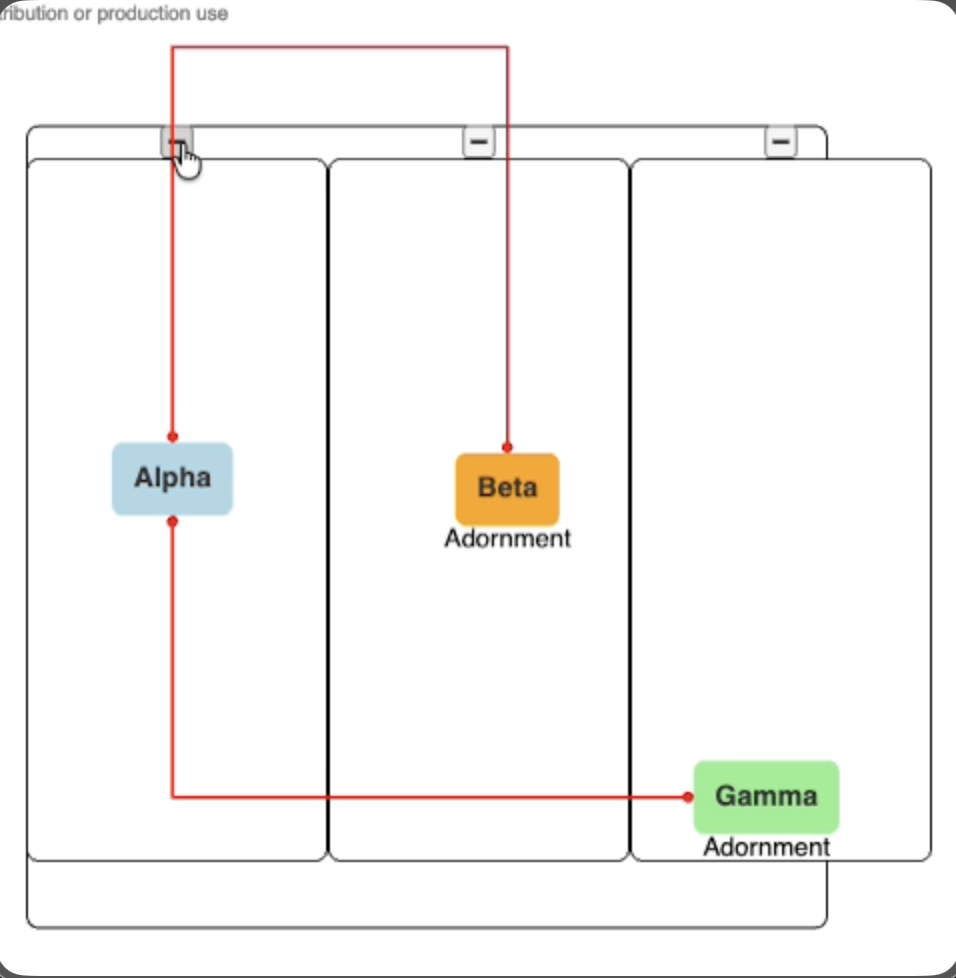
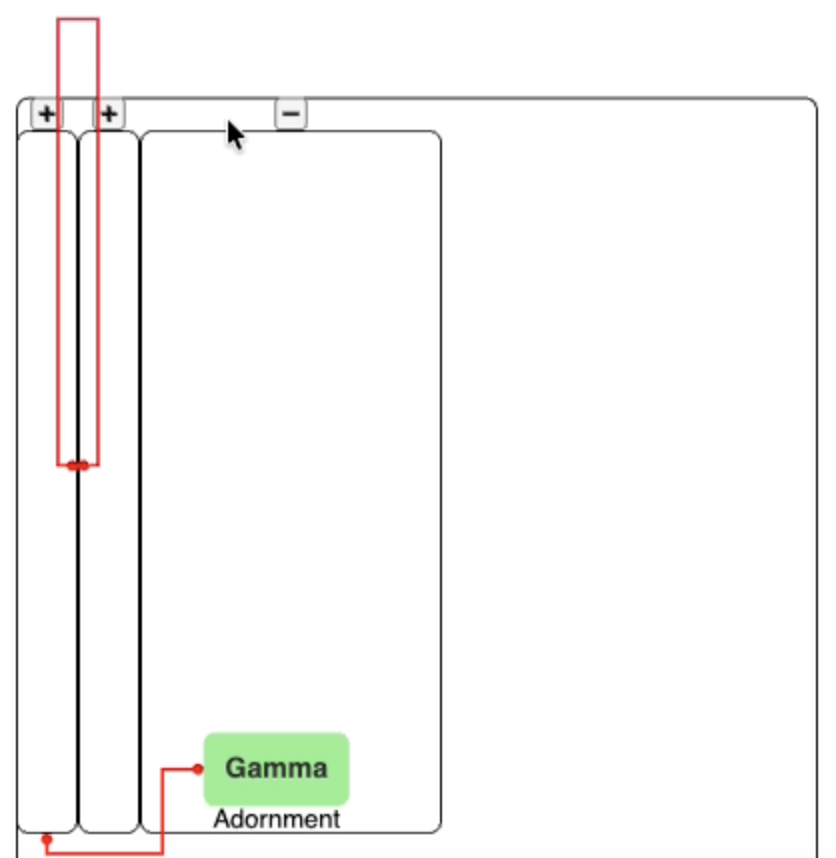
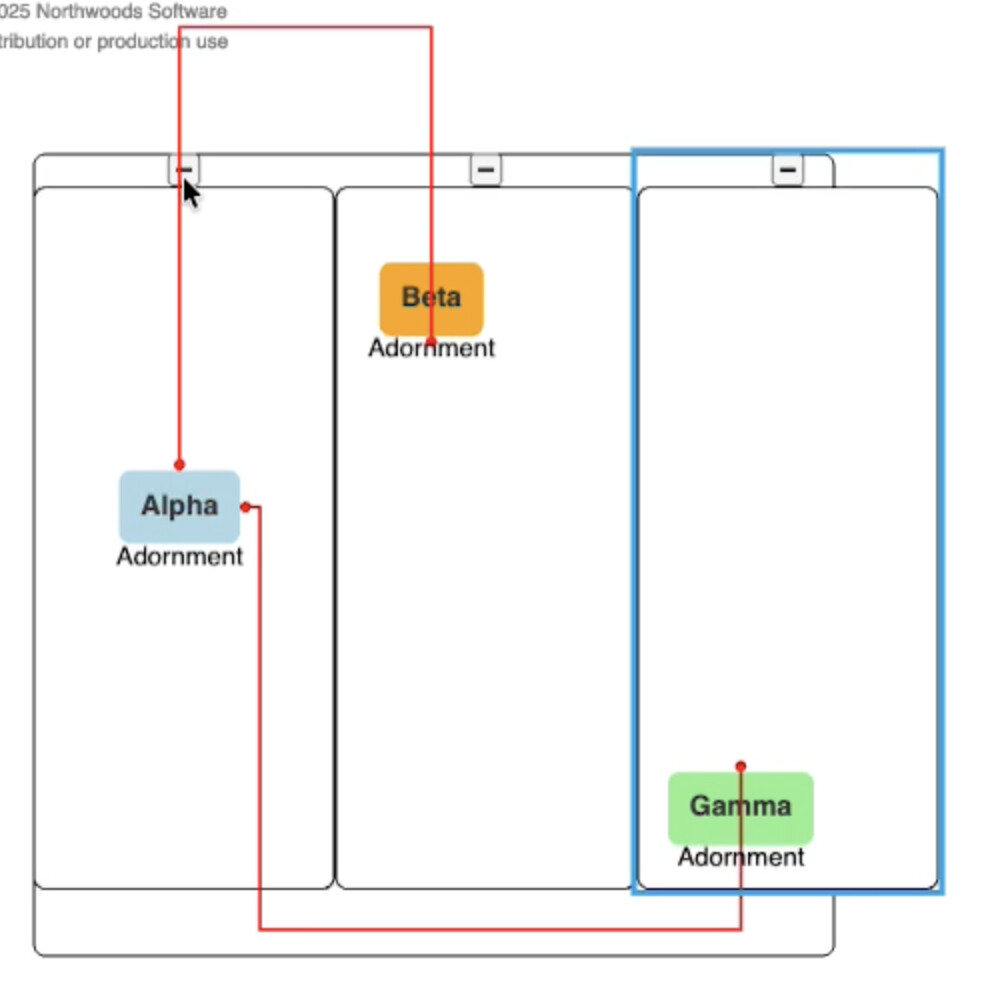
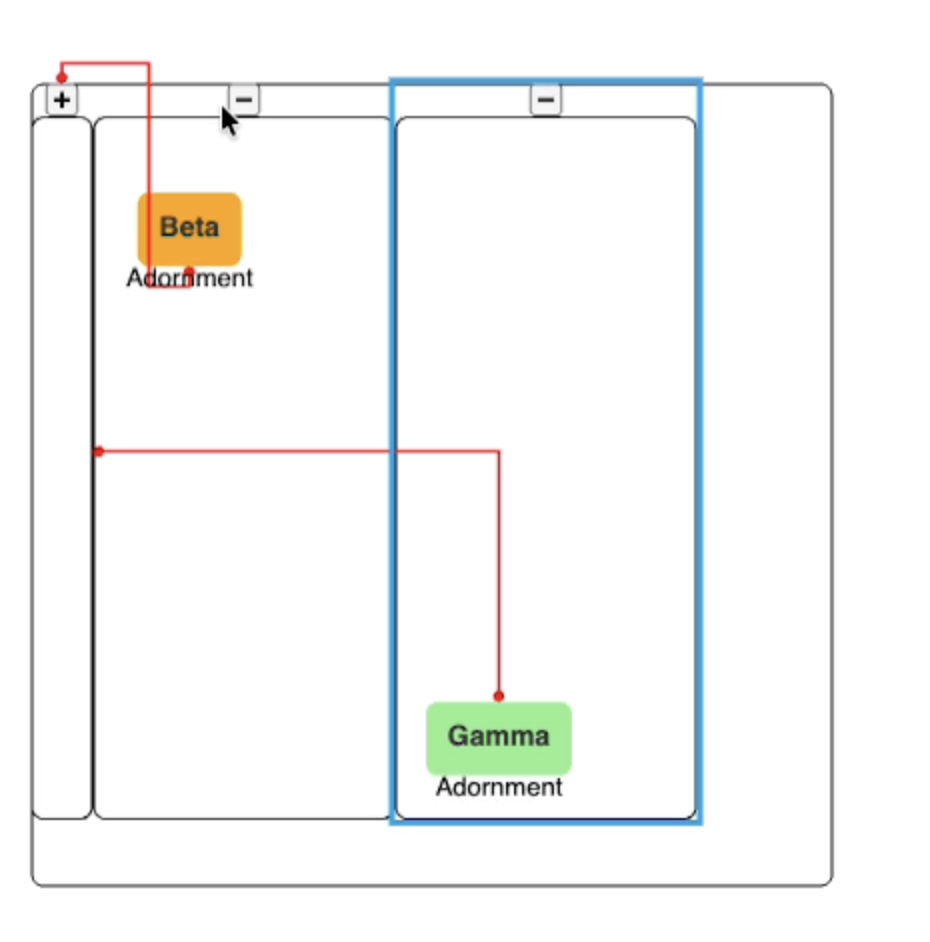
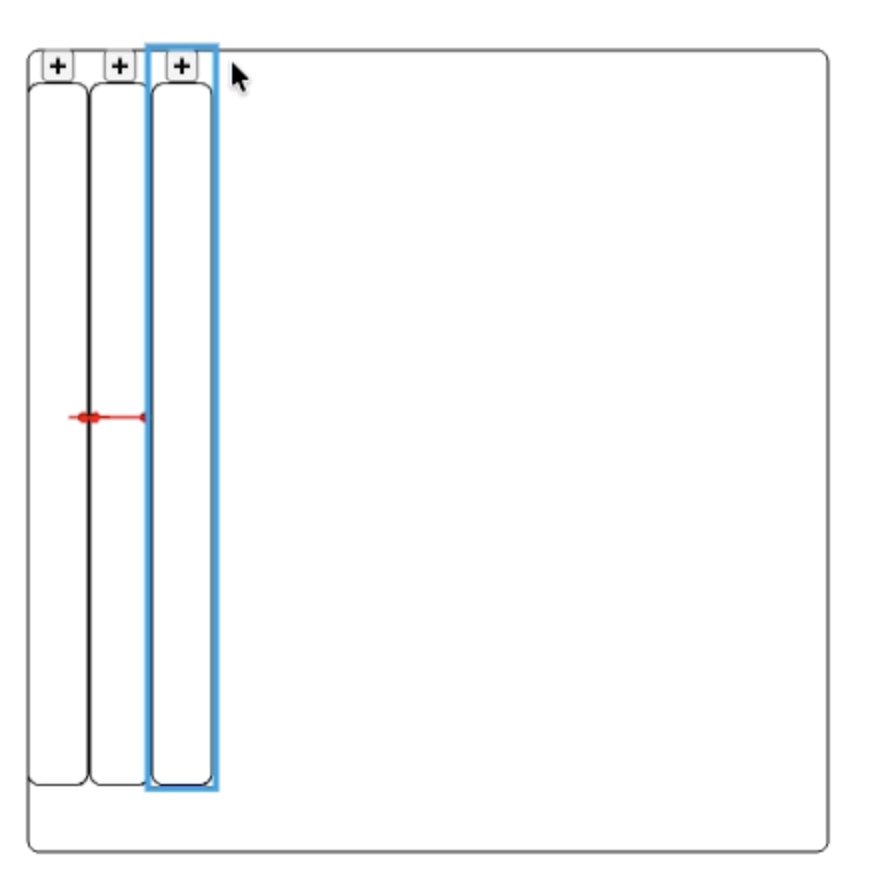
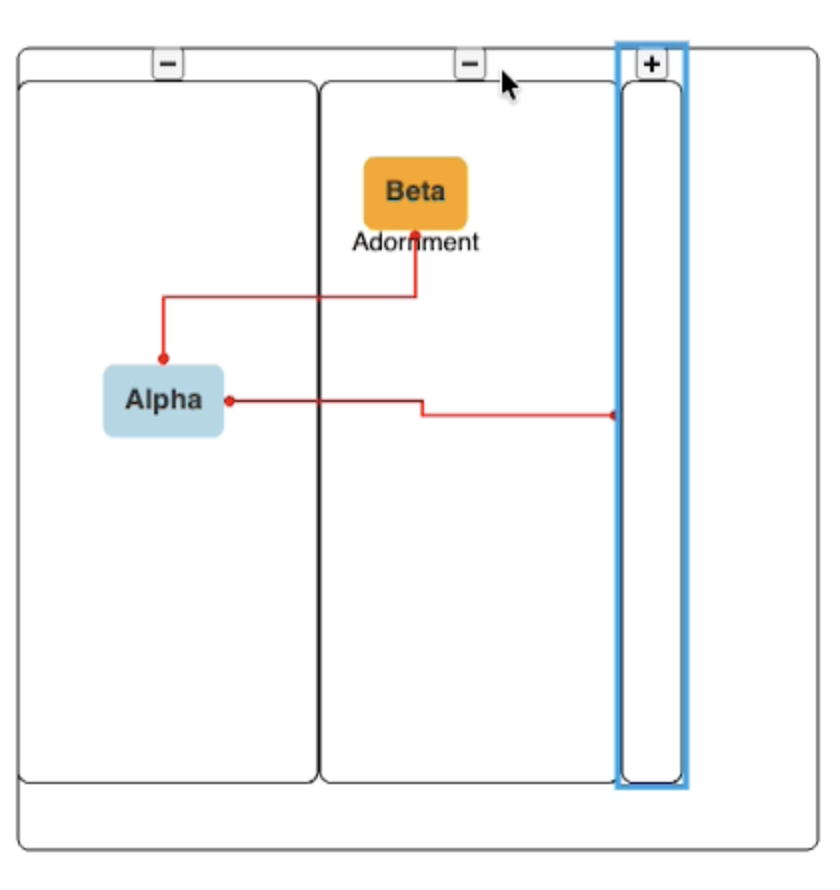
Here I have replaced your implementation of each Node’s “Adornment” using a subclass of Node. Note how there is no odd Binding on the node template.
<!DOCTYPE html>
<html lang="en">
  <body>
    <script src="https://cdn.jsdelivr.net/npm/[email protected]/release/go-debug.js"></script>
    <div id="sample" style="display: flex">
      <div
        id="diagramDiv"
        style="border: solid 1px black; width: 600px; height: 600px"
      ></div>
    </div>

    <script id="code">
class AdornedNode extends go.Node {
  static AdName = "Adornment";
  static AdTemplate =
    new go.Adornment("Spot")
      .add(
        new go.Panel("Vertical")
          .add(
            new go.Placeholder(),
            new go.TextBlock({ text: "Adornment" })
          )
      ).copyTemplate(true);

  constructor(paneltype, init) {
    if (typeof paneltype === "object") { init = paneltype; paneltype = undefined; }
    super(paneltype);
    if (init) Object.assign(this, init);
  }

  // this design assumes the "Adornment" should only be shown when Node.isHighlighted is true
  maybeShowAdornment() {
    let ad = this.findAdornment(AdornedNode.AdName);
    if (this.isHighlighted && this.isVisible()) {
      if (ad === null) {
        ad = AdornedNode.AdTemplate.copy();
        ad.adornedObject = this;
        this.addAdornment(AdornedNode.AdName, ad);
      }
    } else {
      if (ad !== null) {
        this.removeAdornment(AdornedNode.AdName);
      }
    }
  }
}

const diagram = new go.Diagram("diagramDiv", {
  "animationManager.isEnabled": false,
  "LayoutCompleted": e => {
    e.diagram.links.each(l => l.invalidateRoute());
    e.diagram.nodes.each(n => {
      if (n instanceof AdornedNode) n.maybeShowAdornment();
    })
  },
  "undoManager.isEnabled": true
});

const nodeTemplate = new AdornedNode /*go.Node*/("Auto", {
    // when Node.isHighlighted changes value, call AdornedNode.maybeShowAdornment
    highlightedChanged: node => node.maybeShowAdornment(),
    // user can control which nodes have "Adornment" by double-clicking
    doubleClick: (e, node) => {
      e.diagram.commit(d => node.isHighlighted = !node.isHighlighted)
    }
  })
  .bindTwoWay("isHighlighted", "isAdorned")
  .bindTwoWay("location", "location", go.Point.parse, go.Point.stringify)
  .add(
    new go.Shape("RoundedRectangle", {
        strokeWidth: 0,
        fill: "white",
        fromSpot: go.Spot.AllSides,
        toSpot: go.Spot.AllSides,
        portId: '',
      })
      .bind("fill", "color")
      .bindTwoWay("fromSpot", "fromSpot", go.Spot.parse, go.Spot.stringify)
      .bindTwoWay("toSpot", "toSpot", go.Spot.parse, go.Spot.stringify),
    new go.TextBlock({
        margin: 8,
        font: "bold 14px sans-serif",
        stroke: "#333",
      })
      .bind("text")
  );

const poolTemplate = new go.Group("Auto", {
    layout: new go.GridLayout({
      alignment: go.GridAlignment.Position,
      comparer: (a, b) => a.position.x - b.position.x,
      spacing: new go.Size(0, 0),
      cellSize: new go.Size(0, 0),
      wrappingColumn: Infinity,
      wrappingWidth: Infinity,
      isRealtime: true,
    })
  })
  .bindTwoWay("location", "location", go.Point.parse, go.Point.stringify)
  .add(
    new go.Shape("RoundedRectangle", {
      strokeWidth: 1,
      fill: "white",
      width: 400,
      height: 400,
    })
  );

const laneTemplate = new go.Group("Vertical", {
    isSubGraphExpanded: true,
    fromSpot: go.Spot.LeftRightSides, toSpot: go.Spot.LeftRightSides
  })
  .bindTwoWay("location", "location", go.Point.parse, go.Point.stringify)
  .bindTwoWay("isSubGraphExpanded")
  .add(
    go.GraphObject.make("SubGraphExpanderButton", {
      click: (event, thisObj) => {
        thisObj.part.diagram.startTransaction("Toggle");
        if (thisObj.part.isSubGraphExpanded) {
          thisObj.part.collapseSubGraph();
        } else {
          thisObj.part.expandSubGraph();
        }
        thisObj.part.diagram.commitTransaction("Toggle");
      },
    }),
    new go.Shape("RoundedRectangle", {
        strokeWidth: 1,
        fill: "white",
        width: 150,
        height: 350,
      }).bindObject("desiredSize", "isSubGraphExpanded",
        (isSubGraphExpanded) =>
          isSubGraphExpanded ? new go.Size(150, 350) : new go.Size(30, 350))
  );

const linkTemplate = new go.Link({
    reshapable: true,
    resegmentable: true,
    routing: go.Routing.Orthogonal,
    adjusting: go.LinkAdjusting.End
  })
  .bindTwoWay("points")
  .add(new go.Shape({ strokeWidth: 1.5, stroke: "red" }))
  .add(
    new go.Shape({
      strokeWidth: 0,
      fill: "red",
      scale: 0.7,
      fromArrow: "circle",
    })
  )
  .add(
    new go.Shape({
      strokeWidth: 0,
      fill: "red",
      scale: 0.7,
      toArrow: "circle",
    })
  );

diagram.nodeTemplate = nodeTemplate;
diagram.groupTemplateMap.add("Pool", poolTemplate);
diagram.groupTemplateMap.add("Lane", laneTemplate);
diagram.linkTemplate = linkTemplate;

const nodes = [
  {
    key: "P",
    isGroup: true,
    category: "Pool",
    location: "31.24609375 -0.3515625",
  },
  {
    key: "L1",
    group: "P",
    isGroup: true,
    category: "Lane",
    location: "31.24609375 -0.3515625",
    isSubGraphExpanded: true,
  },
  {
    key: "L2",
    group: "P",
    isGroup: true,
    category: "Lane",
    location: "62.24609375 -0.3515625",
    isSubGraphExpanded: true,
  },
  {
    key: "L3",
    group: "P",
    isGroup: true,
    category: "Lane",
    location: "62.24609375 -0.3515625",
    isSubGraphExpanded: true,
  },
  {
    key: "N1",
    group: "L1",
    text: "Alpha",
    color: "lightblue",
    location: "74.30859375 157.82421875",
  },
  {
    key: "N2",
    group: "L2",
    text: "Beta",
    color: "orange",
    location: "150.8359375 88.375",
  },
  {
    key: "N3",
    group: "L3",
    text: "Gamma",
    color: "lightgreen",
    location: "100.37538656080795 203.03515625",
    isAdorned: true
  },
];

const links = [
  {
    from: "N1",
    to: "N3",
  },
  {
    from: "N1",
    to: "N2",
  },
];

diagram.model = new go.GraphLinksModel(nodes, links);
    </script>
  </body>
</html>